Problem
Business Challenges
- Scaling revenue currently required extensive hiring to service accounts.
- Legacy systems were inefficient, slow, and unreliable.
- Account distribution methods caused unequal workloads and inconsistent performance bonuses.
- Leadership needed detailed reporting to track employee productivity and incentivize performance.
User Challenges
- Employees faced decision overload from too much data and unclear task priorities.
- They needed workflows that delivered the right information at the right time.
- Account managers wanted repeated contact with the same customers to build rapport.
- They needed real-time visibility into productivity and performance metrics tied to incentives.
- The systems frequently crashed or required jumping between multiple screens and tools.
Customer Challenges
- Customers needed an easy way to set up and manage payments online.
- They wanted consistent communication with the same representative to build trust.
- Servicing employees had no easy way to share recurring customer pain points with other departments that could help resolve them.
Goal
Streamline workflows, reduce manual work, and help the business scale without needing to hire more employees.
Team and My Role
I was one of four Product designers on the project. We collaborated closely with the product owner, business analysts, developers, and business stakeholders in Agile sprints. My role included both research and design, spanning discovery, prototyping, user testing, and final UI designs.
Design Process
Research and Discovery
- User interviews and surveys with various teams/departments.
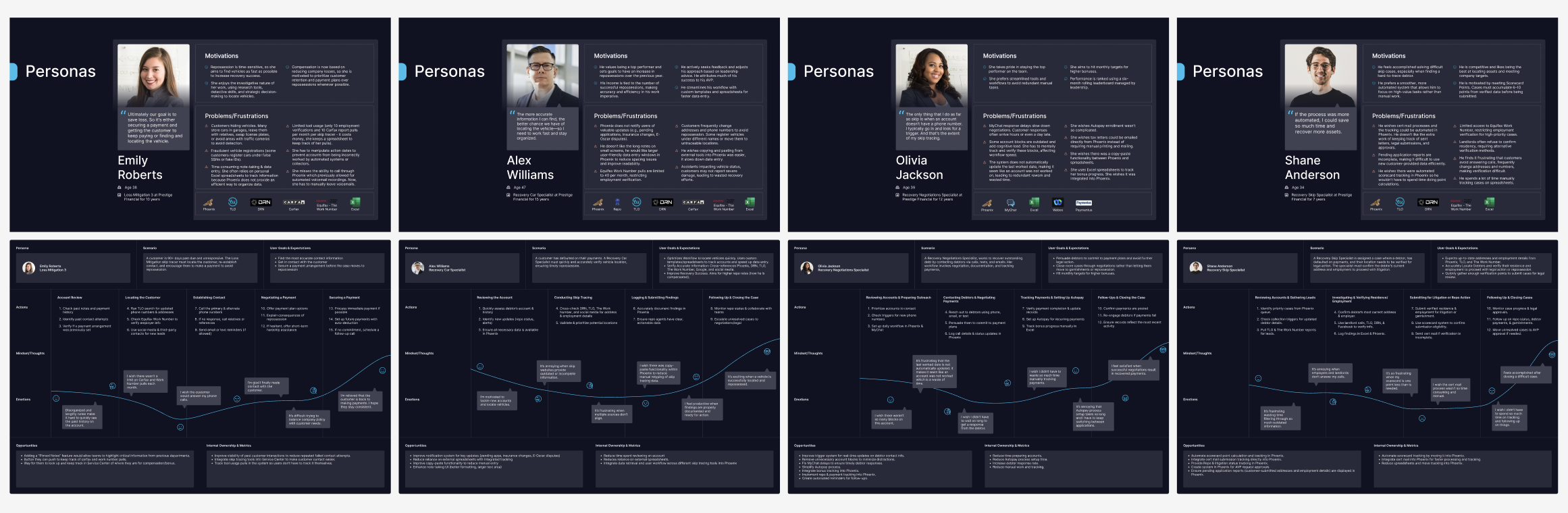
- Created User Personas to understand goals and frustrations by team.
- Journey mapping to visualize workflow inefficiencies.
Ideation and Design
- Created user flows and low-fidelity wireframes to explore new task-based workflows.
- Designed and prototyped interactive experiences in Figma.
- Collaborated via Microsoft Teams, Jira, and Confluence.
Testing and Iteration
- We conducted in-person usability testing sessions using both prototypes and the application in a controlled test environment to evaluate task flows, identify usability issues, and validate design decisions.
- Gathered direct feedback and iterated designs to simplify workflows and reduce cognitive load.
- Redesigned and handed off features between designers based on user and business feedback.
My Contributions
I contributed to multiple areas of Service Center, including research, design, and iterative improvements across several features and workflows.
Design System Collaboration
Our team built a shared Figma component library from scratch, ensuring consistency across the application.
This included standardized typography, colors, and reusable UI element components.
Skip Tracing & Inventory
- Conducted user interviews and created personas and journey mapping for Skip Tracing workflows.
- Conducted contextual inquiries and created a persona and flows for the Inventory team.
- Designed initial inventory interface concepts aligned with identified user pain points.
Account Details
- Redsigned the Account Details Edit section.
- Introduced a new Cease & Desist flow.
.jpg)
Payments, Notifications & Card Redesigns
- Designed the Scheduled Payments feature.
- Updated sidebar cards: Term Details, Multiple Phone Numbers, Spanish Indicator, Cease & Desist, and others.
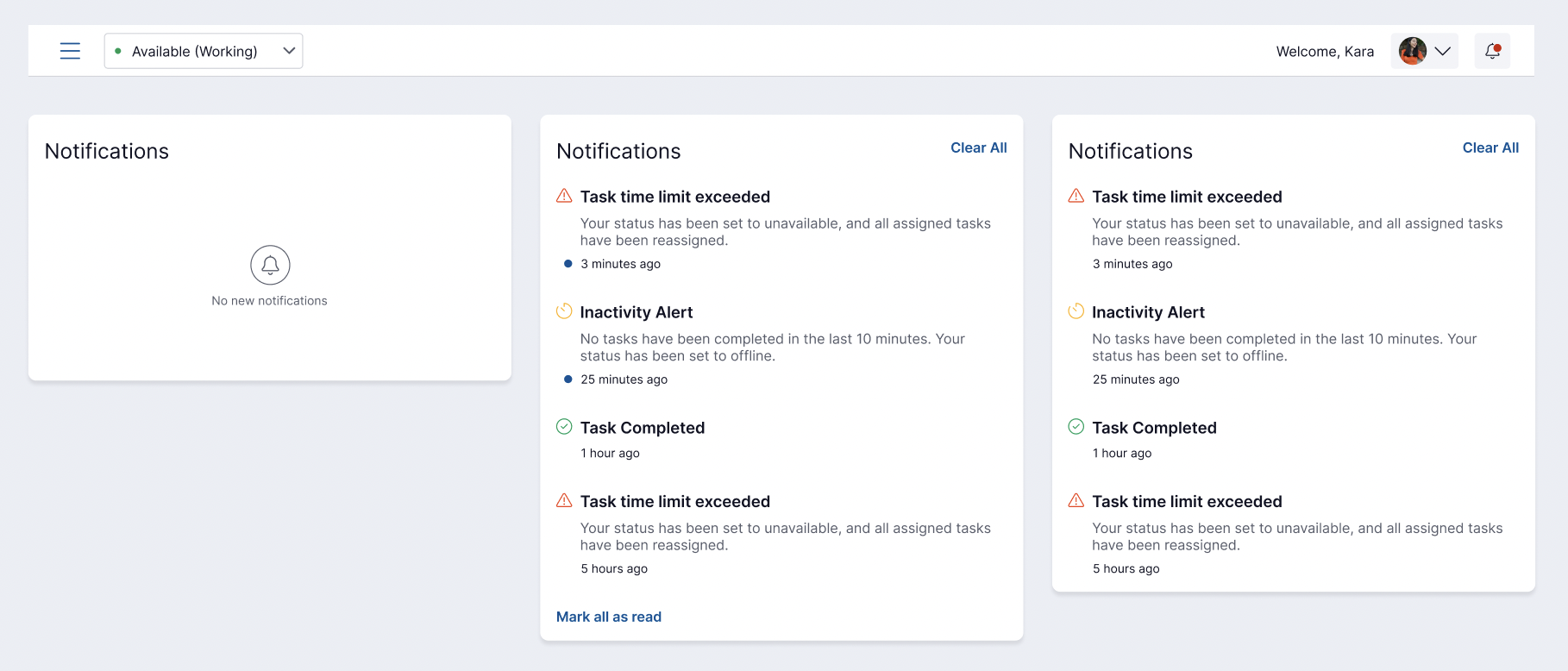
- Created the notification design and flow.
Conversations & Notes
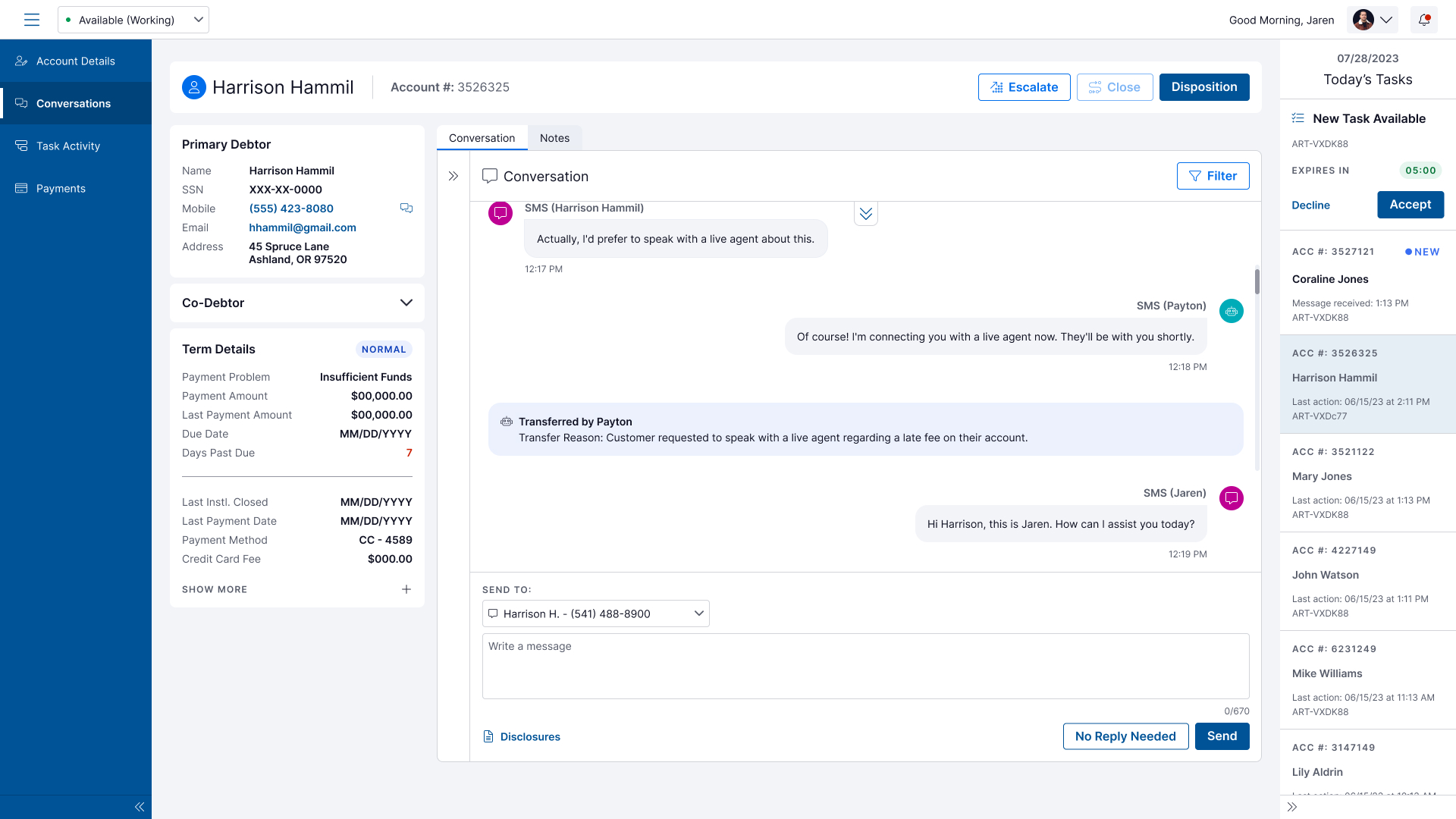
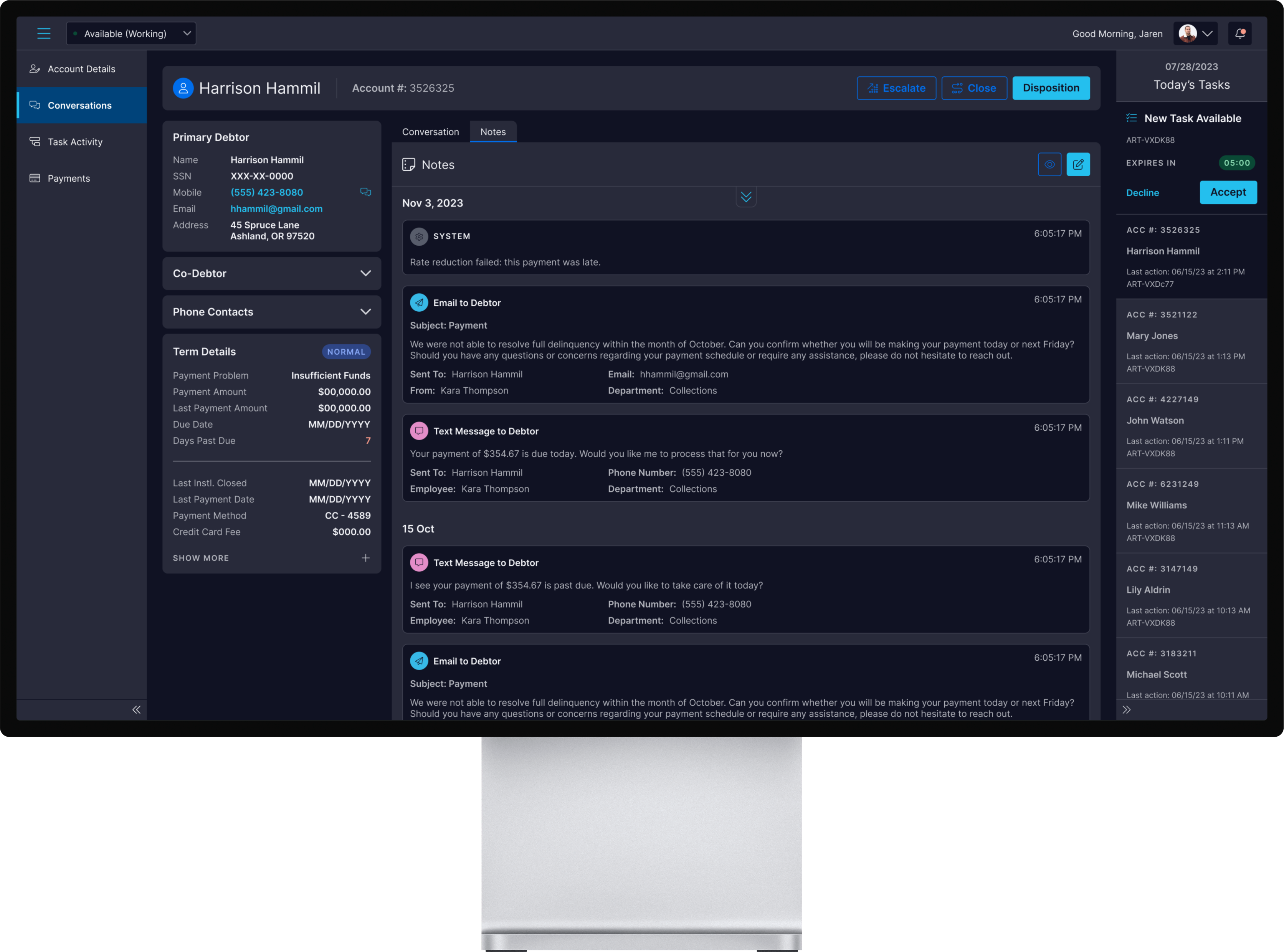
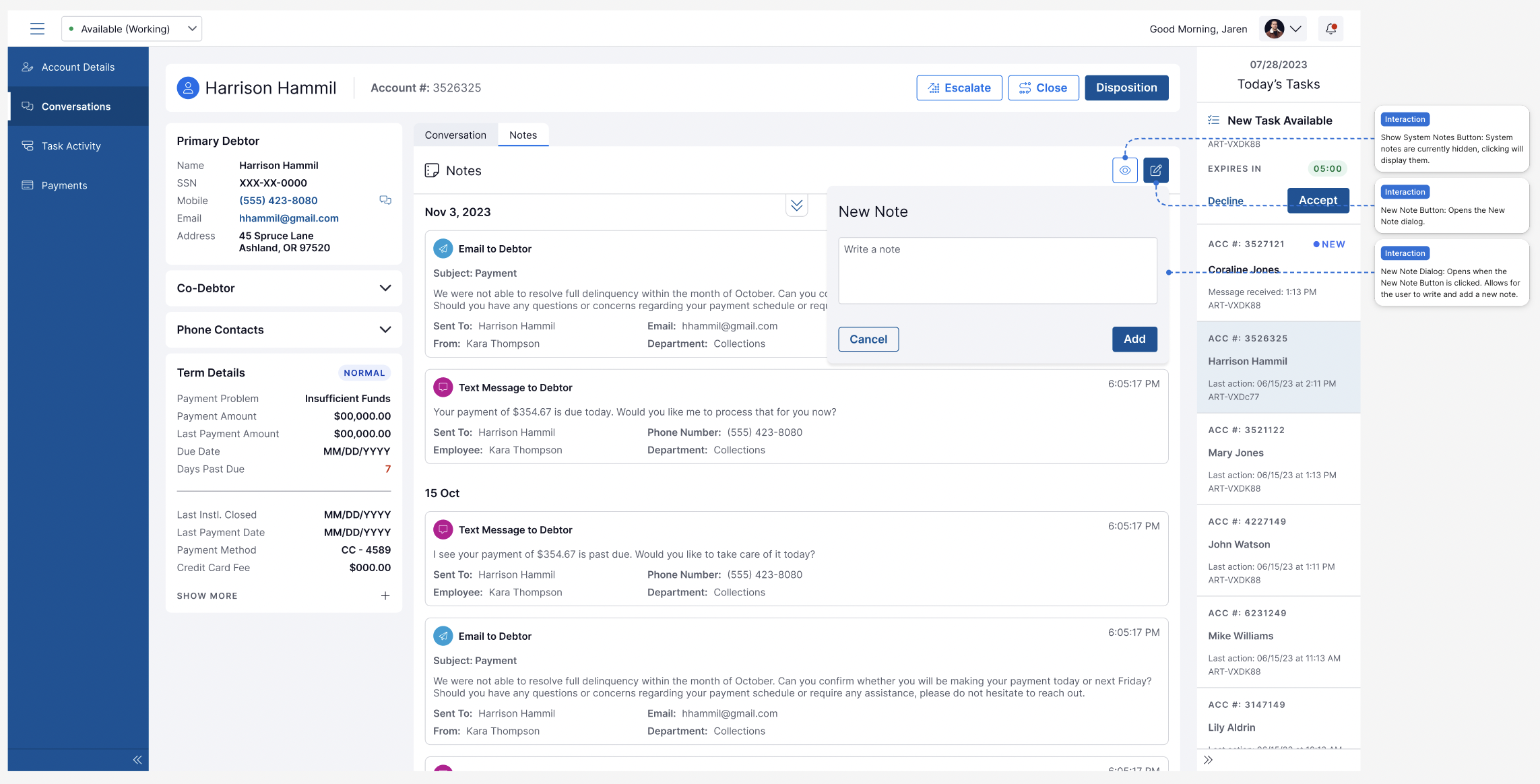
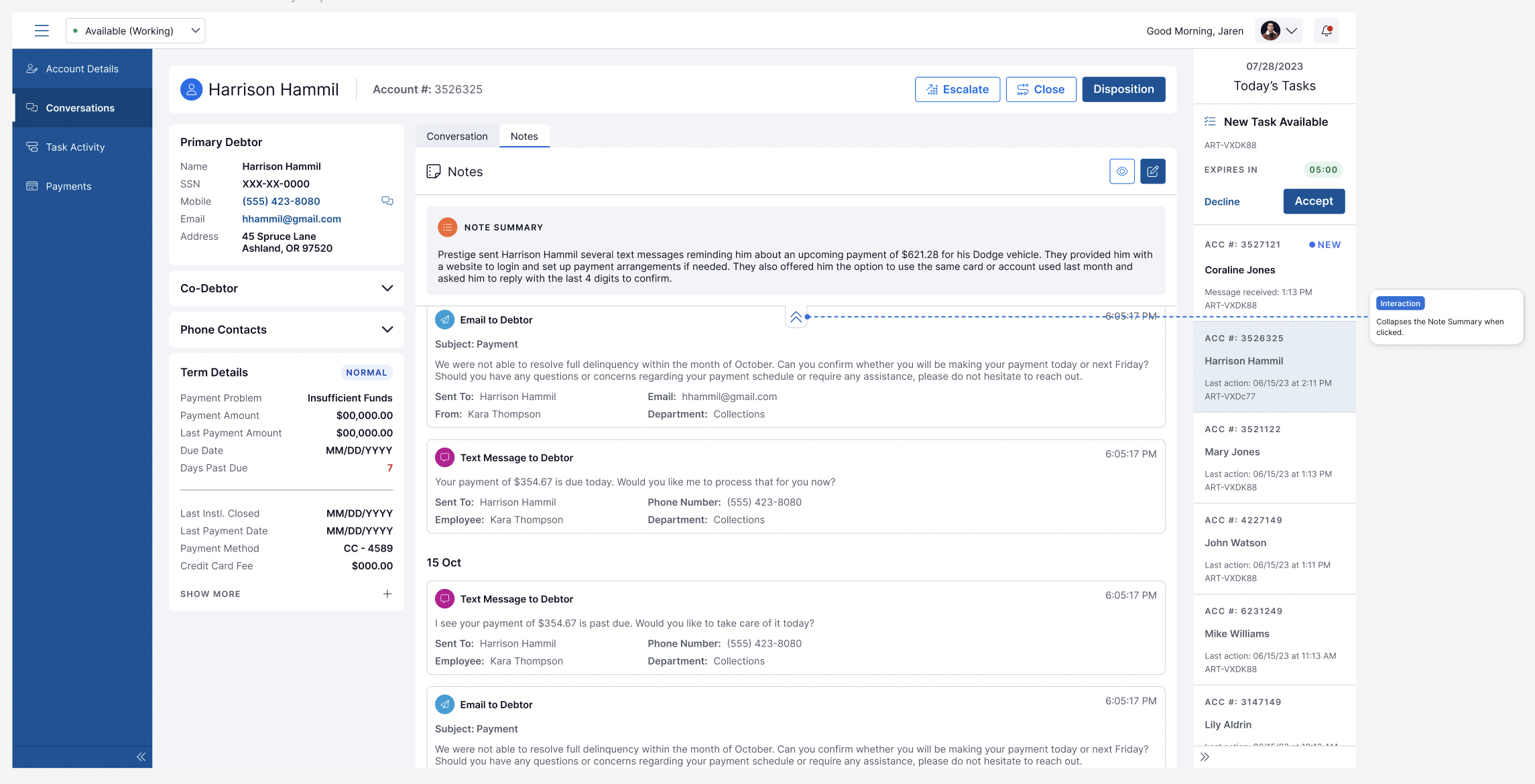
- Redesigned the Conversations and Notes experience.
- Improved send button behavior, message-sending feedback, and the overall clarity of inbound task handling.
- Updated conversation and note summaries for easier readability.
Impact & Results
Users immediately responded positively to the redesigned application:
“This is awesome. I’m not gonna lie. I love this.”
“This is all like wow! I can’t even imagine anything at this level.”
“It looks pretty cool and neat, the old one was just a mess.”
“It seems like it’s going to be pretty easy. I like that.”
The Service Center redesign delivered:
- Simplified and faster account workflows for ICT and ART teams.
- Increased user confidence and satisfaction.
- A scalable structure for distributing tasks by skill and department.
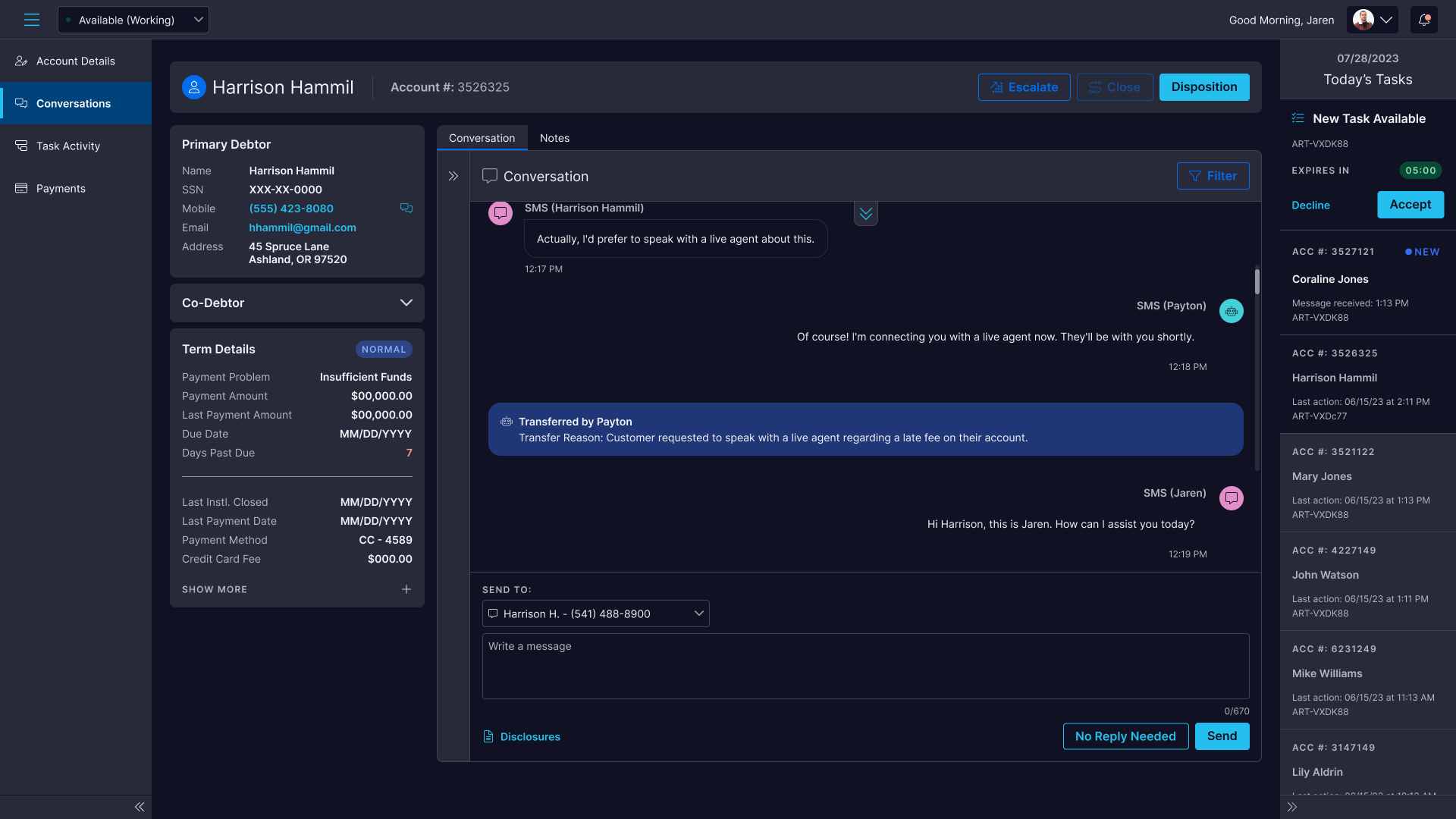
- Light and dark mode options so users can choose the theme that’s most comfortable for them.
Reflection
Working on Service Center taught me the value of collaboration and iteration in large-scale system redesigns.
By combining deep user research with agile iteration, our team transformed outdated workflows into an intuitive, efficient platform that supports both business growth and employee success.